
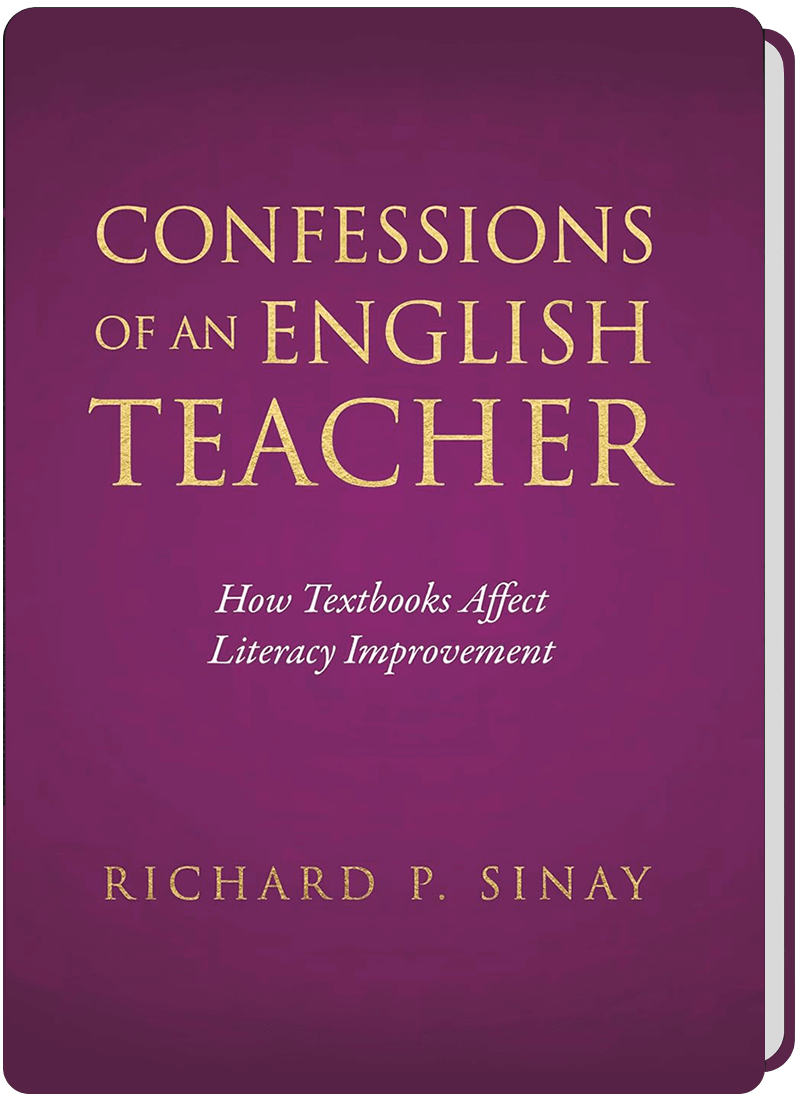
Confessions of an English Teacher: The Problem and the Solution to Teaching Literature to Average Students
Confessions of an English Teacher: The Problem and the Solution to Teaching Literature to Average Students
Writing a book about literature is challenging, especially when one takes on an institution that has been entrenched in California education for many years. While I am not taking on literature, I am challenging how it is taught to average students who make up the preponderance of students in school. Average students are taught from a textbook, and that is what I object to. I believe that average students should have a reading program that develops their literacy incrementally, rather than relying on a textbook that is linguistically and culturally out of touch with them. I present my arguments for why this is necessary in two different sections of the book. The first section illustrates why there are problems with how literature is taught to average students. The second section of the book offers solutions to the problem of how to teach literature to average and below-average students.
Part I of the book demonstrates how literature can be a problem. Chapter 1 argues that textbooks are the culprit in stifling the linguistic growth of average and below-average students. Chapter 2 looks at the “training” of English teachers and how their degree affects their performance in the secondary classroom. Chapter 3 demonstrates that English teachers are actually never trained to teach literature. At no point in their preparation to be secondary school English teachers are they shown how to teach literature. Chapter 4 questions the effects of literature on student literacy. Chapter 5 argues against the teaching of British literature because of the lack of historical context, as well as a variety of other reasons. Chapter 6 boldly argues that Shakespeare should not be taught to average students, given the linguistic gap between Shakespeare's early modern English and contemporary English. Chapter 7 argues against the teaching of American literature in chronological order, given that the textbook selects readings that do not advance students' literacy. Chapter 8 shows how English teachers fresh out of college are more inclined to “act” like little professors of literature than literacy coaches. Chapter 9 argues that all literature that does not fit students, either linguistically or culturally, should be dismissed.
Part II of the book argues that there is a solution to the problem of teaching frustrational literature. Chapter 10 argues that English teachers should be reading teachers rather than literature teachers. The distinction concerns the role of the English teacher in average classes. The English teacher should be a cheerleader for reading and convince students that their literacy development depends on how much time they spend reading. In Chapter 11, I argue that the goal of teaching English is to advance students' literacy through reading and writing. I argue against the notion that English teachers are there to make students love or understand literature and its associated terminology. I am not saying they should abandon this, but it should not be the primary goal; improving their literacy should be. Chapter 12 distinguishes between the traditional approach to teaching average students and the new approach I am proposing: a Step Ladder Approach to improving their literacy by focusing on reading literary works that are linguistically and culturally appropriate for them. Chapter 13 demonstrated that English teachers, even in my high school days, did not know how to assign literature. They had us reading so many books that we were far above our reading levels. They were ignorant about the readability of novels. They also did not know their students' reading levels.
Chapter 14 discusses the importance of readability and cultural relevance to improving literacy. Chapter 15 provides proof of the textbook's poor readability. Chapter 16 explains why literature can be frustrating to read. Average students spend too much time at the frustrational level of reading. Chapter 17 tells the story of how I had to defend using a textbook to teach junior American literature in chronological order when a bright student questioned why we had to “read all this stuff.” Chapter 18 offers the independent reading program to advance the literacy of average students. Chapter 19 offers insight into why there should be two tracks of curriculum for the secondary English major and for the English major who wants to teach at a community college or a four-year college.
As I have indicated, Part I presents evidence that reading textbooks is not the optimal way to improve the literacy of average students, yet they are the only ones forced to use them. It is a publishing company's demand and a state educational tradition to show parents that their students are being educated by having a textbook. Part II offers a solution to using the textbook. The solution is to create a reading program featuring different literary works, some from the textbook and most purchased independently, such as novels and nonfiction readings. In short, it should be a custom-designed program like the advanced students have for Advanced Placement English, honors classes, or International Baccalaureate programs.